"THERE IS SOMETHING SPECIAL ABOUT KYRGYZSTAN ..."
... it gets into your blood, under your skin: Nobody knows exactly what it is, but there is something about this country that excites visitors - makes them want to extend their stay or at the very least to return.
Is it the spectacular scenery; the wildlife; the troditional nomadic culture; the distinctive crafts; the atmosphere connected with the many historical places and orchaeologicd sites connected with the Greet Silk Rood the Mongol Hordes the Bolshevik Revolution; or the variety of possible ocftvities; the hosptolity of the local populace ... or is it o combination of all of these factors?
Whatever it is there is something that makes Kyrgyzston 'speciol. It is o small country with Over 93% of the territory classified as -mountainous'. The peaks and vdlzys the landscape into quite distinct landscapes, microclimotes and habitats It is possible to encounter many different experiences in small geographical area. and o short space of time.
The Kyrgyz themselves recognize the uniqueness of the country as is shown in some of their legends One such legend tells how Cod was allocating plots of land to the various people of the world offer the creation. The KYPPYZ, whilst waiting in line with the others that is was taking too long and he needed to go and tend to his sheep. Wren he returned he discovered that Cod had finished his task. and he asked -What plot of land shell I have to call my own?" God replied that that oil the land had been allocated and there was none left The Kyrgyz said that he did not need o lot of land, it did not hove to hove lots of riches - it just hod to be sufficient for him to pasture his flocks. God took pity Cf I him and said that there twos o little plot of land kzft He had been intending to keep it for Himself as garden for his own rest and relaxation, but the Kyrgyz could use it for posturing his flocks
Many visitors. however know kft about the country before they arrive. One journalist has claimed that Kyrgyzstan is 'arguably the worlds least-Wwn country? Whereas that may, or may not, have been true when it was written. (he did soy -orguobly-), time has passed and in recent times Kyrgyzston has occasionally oppectared in the worlds media. Even so. many people still get confused about the Storks in general, and hove only a scant idea about where Kyrgyzston is, and what can be found here.
The journalist however, Certainly Summed up how I felt about the country when I first arrived (tor o 10 day holiday), bock in 1994. At that time it was very difficult to find out anything about this once remote corner of Central Asia - one of the smal landlocked states to emerge from the former Soviet Union that lies in the heart of the Eurasian continent and once straddled the Cleat Silk Rood. Obviously, in school hod learned about the Great Sdk Rood, and about historical characters such as Cenghis Khan and Torrerlone but I had, really. no idea of what to expect as I descended steps from the oirplane. I would have untamed o magazine such as Discovery Kyrgyzston to open a window onto this country of contrasts: its variety of landscapes and wildlife, peoples and cultures history and traditions. Kyrgyzsten is a land of contrasts Even though it is only o small country, within its borders there are o multitude of spectacular landscapes: on abundance of wildlife - much of it very rare and endangered; o multi-ethnic population representing Over 80 different nationalities each preserving their only culture, traditions and cuisine - primarily, of Course, the rornad.c Kyrgyz; numerous sites of historical interest and importance and a range of possible activities from maintoincering, trekking, rafting, skiing. or even just sitting on a beach, relaxing in the sunshiny. In short there is something for everyone.
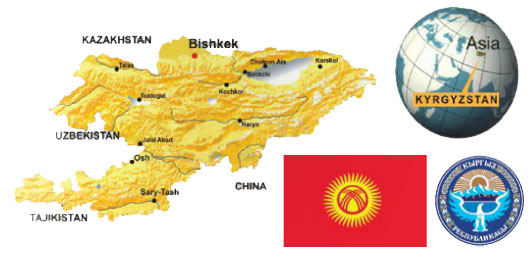
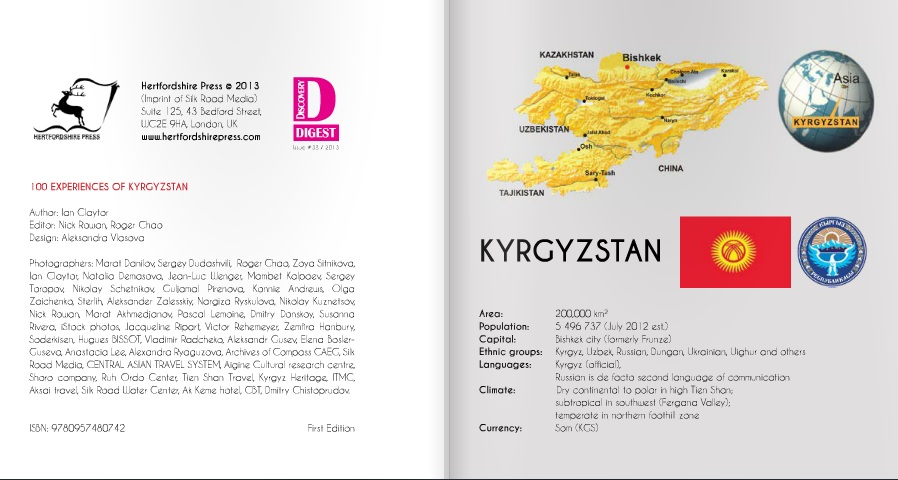
Kyrgyzstan (or The Kyrgyz Republic, to give the country its official name) lies at the very centre of the Eurasian continent, bordering China (to the east), Kazakhstan (to the north and west), Uzbekistan (to the south and west), and Tajikiston (to the south west and south).
Actually, the geographical centre of the Asian continent lies about 1.030(cm further north but the term -Central Asia' is widely used for this region and if you loot at o mop of the two continents together Kyrgyzston does, more or less. k in the centre.
It is a small, landlocked, mountainous country occupying just less than 200.033 square kilometres about the size of kfitugot Switzerland, Belgium and the Netherlands put together or o little less than the UK.
The northernmost part is on the sane latitude as Rome but, because it is landlocked winters are much colder (and the height above sea-level makes many areas even colder. For example, Naryn fairly often experiences temperatures of -35' C in winter). Summers are both drier and hotter (45° C is not unusual and 50° C was recorded in I998 near Bishkek).
Over 90:6 of the surface area is over l,500m in height and therefore counts as mountainous (although not all of it consists of peaks there being numerous plateaus and wide inter-mountain valleys), and 4| 36 is over 3.030m high.
The greatest natural feature is the Tien-Shan mountain range (in Kyrgyz ’Tenir-Too") running
northeast to southwest.
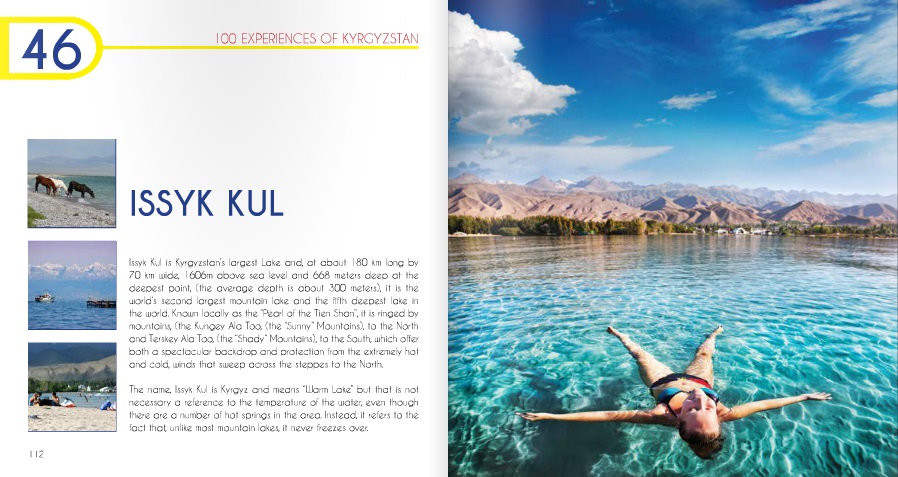
The second most famous feature is Lake Issyk-Kul, (which is Kyrgyz for ‘warm lake'. It never freezes hence its name). The lake lies at an altitude of |.olIlrn above sea level in a basin surrounded by high mountains and is 668m deep in places.
It is not far by road (about three hours) from the second largest lake in Kyrgyzstan Lake San Kul which lies at 3,003 meters. A remote but beatiful wildlife sanctuary. The river Naryn runs from north east to south west ioining with the Kara-Darya to form a river which even in antiquity was called the Syr-Darya and which runs from Kyrgyzstan out into the Ferghana (Fergana) valley and on into the Aral Sea (though it is mainly diverted or exhausted before then). This is the second largest river in central Asia after the Amu-Daryg It is possible to visit its source. Above the city of Naryn.
The Kyrgyz are reckoned to be one of the oldest distinct nationalities and are mentioned it old Chinese chronicles They were basically a pastoral nomadic people travelling from jailoo to jailoo with their flocks. (A jailoo is a high mountain pasture, the lower pastures are called kyshtoo) For a long time they were confused with the Kazakhs who were called Khirghiz. whilst the Kyrgyz themselves were called Kara Kyrgyz It is said that the two nations are closely related but that the Kyrgyz were nomads who travelled from place to place high in the mountains whilst the Kazakhs travelled from place to place down around the steppes both nationalities were renowned warriors.
Unlike its neighbours Uzbekistan and China, little evidence of Kyrgyzstan's noble and ancient history has survived.
The country has seen many civilizations and empires rise md fall such as the Saks (known as the Scythian: in the West), the Mongols, the Russians and the Soviet Union. Nantes such as Alexander the Great. Marco Polo. Genghis Khan Tarnerlane and Babur...are cl associated with the region The connection is stronger in some cases than in others we are not quite sure exactly how far north Alexandm the Great reached but it is thought by sortie that he conquered the Chui valley. ousted the existing ruler. (Prince Shu), and made it to lssyk Kul where he left hostages (mainly noble families from Iran) in a settlement on the southern shore which later became Barskoon As far as we know Marco Polo
never came further north than Kashgar having travelled through modern—day Afghanistan. Genghis Khan and his horde of Mongol warriors did travel through the region sacking towns and cities which defled him but sparing others ike balasugan which opened their gates to his army. One of his wives is reputed to be buried on the ‘Genghis Khan Highway’. track high in the mountains in the Talas region.
Tamerlone was born grew up and based his empire on the Uzbek city of Samarkand but came through the territory of Kyrgyzstan on his oclnpaigns against the Chinese and there are several stories relating to him including a few archaoologioal sites babur who founded the Mogul Roi In India. grew up in Osh. Although the Kyrgyz themselves at one time had a large empire, this tell into decline and they became the subject people of a range of empires over the centuries.
Some cities such as Osh, (which claims a 3.0.1) year history of continuous human settlement). may have a long history but only isolated remains of man's early settlements in the region can be seen and most of the great cities at the past are now little more than archaeological sites It is possible to get a feel of the past at such places as Burana. near Tokmak the Manas Gumbez (mausoleum). near Talas the Uzgen complex, and the Tosh Rabat caravanserai in the Naryn province on the road to Torugart and the Chinese border.
ANCIENT TIMES
Man first appeared in the land that is now known as Kyrgyzstan in ancient times and there is archaeoloaicd evidence of early settlements For example; - At Tosor. on the Southern shore of Lake
lssyk Kul archaeologists have found the site of an ancient (Paleological) settlement — said to date from 50,000 BC (I). (a recent book says anywhere between 100,000 and 40,000 years old).
- In the 1950's during the construction of Alomedin Hydroelectric power station, (near Bishkek), stone tools dating from 6000 years ago were discovered. - Osh, Kyrgyzston's second city - the 'Southern Capital' of the country - has been the site of human settlement for over 3000 years).
Potro9IYIths. (stone inscriptions), ore found at various places throughout the country and also provide evidence of early man's existence - his life, religion and culture.
Unfortunately, only o few examples of old buildings or settlements remain. The eody inhabitants were nomads, and the great cities which did exist in the post hove long since disappeared. Many buildings were made of cloy and (like may mausoleums that can be seen throughout the countryside) have been eroded so that only archaeological excavations can reveal the true extent of much of Kyrgyzstaris early history.
The nomadic peoples did not leave written records either - their tradition was on oral one - and what written records there are come from other sources - Chinese, Arob, and the accounts of travellers and traders.
A TROUBLED REGION
The region has experienced troubled time being crossed several times by marauding armies
- from before the time of Alexander the Great to modern times, such as:
- The armies of Chino, who reached the western extent of their expansion when they were defeated of the Battle of Tolos in 751 AD.
- The Mongols under Genghis Khan,
- The armies of Timur (Tamerlane),
... and in more recent times
- Tsarist Russiq - The Civil War and
- the Bosmachi revolt
Most accounts of the history of the region tend to start in the 1st Millennium BC - when the Kyrgyzstan was at the southernmost port of land occupied by the Sok peoples -whom the Roman historian, Herodotus, called kythions. (It is claimed that some of the early historical sources suggest that these people included some references to a particular pointed felt hat - very similar to the Wool; which is still worn by the Kyrgyz today).
Alexander the Great extended his Macedonian Empire to Centro! Asio - but his armies never conquered the Saks. Instead they headed South and turned their attention towards India.
At the end of the second century BC, the area came under the Hun Empire, which was a large confederation of nomadic tribes. The Huns marched West and nearly conquered Rome. The empire, however, proved to be too vast and collapsed into historical oblivion The Tokhars rose to fill the power vacuum created by the collapse of the Hun Empire, only to replaced in their turn by the Usun tribes (who saw the rise of the trade network now known today os the -Silk Rood') - and then the Turkic Empire (from which the people of modern Turkey trace their descent).
In the 6th to 9th Centuries - large settlements, such os bolosagon and Barskoon, rose and flourished then went into decline and disappeared.
The unification of Turkic tribes gave rise to the LUestem Turkic Khonate (there was later on Eastern version) the capitol of which was Suyob situated in the Chui valley, (Bishkek lies in this volley). In the 10th-12th centuries, the Koro-Khonid Khonate (or Koro-Khitoi Empire - like in Russian still means-Chinese") developed.
From the Mai Mountains the Kyrgyz displaced the Uighurs who themselves moved south to the steppes of western Chino (later Turkestan) and in turn displaced the loco! Turkish peoples
All was swept aside with the invasion of the Mongols under Genghiz Khan. After his death, the empire was divided amongst his sons ... the land that is now Kyrgyzston became part of the Chogotoi Khonate.
Tamerlane, (or Timur the lame), was one of Genghis Khan's descendants and rose to power leaving a mixed heritage marked by ruthless cruelty and sponsorship of learning -both artistic and scientific
Later, this became the Kokand Khanate, dominated by Uzbeks from the south, but following an uprising in 1870's the Kyrgyz were finally brought under the sway of the Russian Empire following the expansion of the latter in the second half of the 19th Century.
The land that now forms the Kyrgyz Republic was assimilated into the Russian Empire in the nineteenth century and after the
October Revolution became port of the Soviet Union - eventually becoming one of the sixteen Republics in 1936.
The Kyrgyz people, formerly nomadic were - like others in central Asio - subject to o campaign of settlement and collectivization under the Soviet Union in its formative period which left o large percentage of the population dead from starvation and disease. However, it cannot be denied that in later years the Russian presence led to many benefits in the forms of heavy subsidies enabling the relative modernisation of the country and its infrastructure. Many Kyrgyz still give the Soviet Union credit for the modernization of the country: factories, roods railroads airports modern housing and power stotions, os well as improvements in the education system and opportunities for young people, and the health and social security system. The country was one of the most favoured holiday destinations for Soviet citizens, who flocked especially to the many resorts on Lake Issyk-Kul. Literacy rotes ore high. Today, many Kyrgyz still feel admiration, and even gratitude, for the development that took place in this period. The present doy borders of Kyrgyzston, (Khirgizio, the Kyrgyz Republic) were drown up by the new Russian authorities and later redrawn under the Soviet Union, (for example, part of the Ferghana valley near Osh was ceded by Stalin to the Uzbeks). Even today there remain some border disputes, particularly in the south where enclaves of Uzbek land are totally encompassed within the borders of Kyrgyzston. (Talks are going on to resolve these.)
Tensions were not far from the surface ... in 1990 the republic declared its sovereignty and in 1991 seceded from the Soviet Union following the abortive attempted August coup in Moscow. It become one of the worlds newest independent stoles and the government undertook a series of reforms with the support of various international organizations and is making strides into the 2 I st century.
In 2CO5 and 2010 the country leapt into the worlds attention when popular uprisings led to the fall of the incumbent governments. In 2CO5, protests over the results of the parliamentary elections led to the storming of the White House, (the Presidential Palace and Government House in the heart of Bishkek) and the fall of the government of President Askor Akoev. He was replaced os President by Kurmonbek bakiev who repeated many of his predecessors mistakes and was himself toppled in the popular uprising of 2010.
THE KYRGYZ
The Kyrgyz themselves are one of the oldest nationalities in Central Asia - mentioned in ancient Chinese texts over 2000 years ago - 2003 was being dedicated as the 2200th year of Kyrgyz Statehood (The word "Kyrgyz" means something like "forty tribes").
The commonly held view is that they travelled to Central Asia from the Yenesei region of Siberia and established themselves as o power in the mountainous region, of first os port of tribal alliances of various nomadic groups and eventually carving out the Kyrgyz Kogonot, although some scholars soy that these were representatives of some of the "forty tribes" and that others were already occupying the land now known os Kyrgyzston.
The Kyrgyz which descended upon the Uighur Empire around 832 - were o forest dwelling people from the Yenesei region in Siberia - some 40 days travel from the Uighur capital of Korabalasugin - o place where the trees grew so tall "that an arrow could not reach their peaks". They hod been in conflict with the Uighurs for some 20 years ... and succeeded in evicting them from balasugan to the Chinese borders where they fell easy victims to the Chinese who sought revenge for centuries of usery. The Kyrgyz of this time were, apparently, a toll people with light coloured hair and green or blue eyes. After their defeat of the Uighurs, they quickly returned to their forested homeland, but in the face of any serious opposition, they maintained control over the former Uighur lands. The Kyrgyz Khonote lasted for several centuries - eventually being defeated and replaced by a series of empires. It stretched from the Yenesei River to the eastern Tien Shan in the first millennium AD.